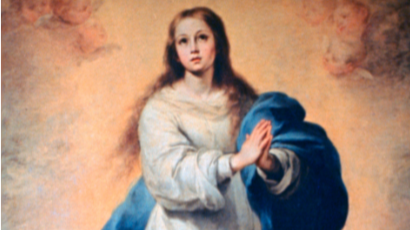
Immaculate Conception
December 7, 2025
Jesus Christ: Yesterday, Today, and Forever ~
This Monday, December 8th, we mark The Solemnity of the Immaculate Conception of the Blessed Virgin Mary, one of only three Marian Feast days that are so special that we observe them as holy days of obligation. To get some idea of how important the Blessed Virgin Mary is to God and thus to the Church and us, look at the list below of Marian Feast days throughout the liturgical year.
· January 1: Mary, the Holy Mother of God
· February 11: Our Lady of Lourdes
· March 25: The Annunciation of the Lord
· May 31: The Visitation of the Blessed Virgin Mary
· May 13: Our Lady of Fatima
· Monday after Pentecost: Blessed Virgin Mary, Mother of the Church
· Nine days after Corpus Christi: The Immaculate Heart of the Blessed Virgin Mary
· July 16: Our Lady of Mount Carmel
· August 5: Dedication of the Basilica of Saint Mary Major
· August 15: The Assumption of the Blessed Virgin Mary
· August 22: The Queenship of Mary
· September 8: The Nativity of the Blessed Virgin Mary
· September 12: The Most Holy Name of the Blessed Virgin Mary
· September 15: Our Lady of Sorrows
· October 7: Our Lady of the Rosary
· November 21: The Presentation of the Blessed Virgin Mary
· December 8: The Immaculate Conception of the Blessed Virgin Mary
· December 12: Our Lady of Guadalupe
So what makes the Blessed Virgin Mary so important?
To answer that we need to go way back to the beginning, to the Garden of Eden. Adam and Eve, the first humans, sinned in the Garden of Eden when they disobeyed God and ate of the forbidden fruit. That first sin is called “original” sin. Adam and Eve were changed forever; in this life, they lost the preternatural gifts of infused knowledge, absence of concupiscence, and bodily immortality (more on that in a bit). What’s more, they couldn’t remove that sin or any other sin that they might acquire in their lives, and their sinful nature would now be inherited by all who came after them, along with suffering and death. Fortunately, from the moment Eve agreed to Satan’s temptation in the Garden, God hatched a plan that would redeem the human race, one that would take place over thousands of years of time. The centerpiece of that plan would be the second person of the Holy Trinity, The Word of God (Jesus), taking on our human nature, suffering and dying as the only sacrifice that could remove all sin from that first one in the Garden, to the last one sometime in the future. This plan was first alluded to when God spoke to Satan, Eve, and Adam after the fall. To Satan he said: “I will put enmity between you and the woman, and between your offspring and hers. He will strike at your head, while you strike at his heel” (Gn 3:15). God foresees three things here: 1) enmity between Satan and the woman; 2) enmity between Satan’s offspring and the woman’s offspring; 3) the heel of the offspring of the woman striking at Satan’s head. The woman in question is the Blessed Virgin Mary, and the offspring of the woman is Jesus Christ. The Blessed Virgin Mary is the new Eve, and Jesus is the new Adam. This powerful pair would remake the human race thousands of years after Adam and Eve would go to their graves.
The Word of God (Jesus) knew exactly when he would enter into time and space as the Messiah (savior) and Christ (anointed one). At the moment he created the universe, he must have known the exact time when he would enter our world as Jesus because he arranged the stars, which have a perfect mathematical calculation, so that the star of Bethlehem would precede him to the place of his birth; furthermore, he created the Blessed Virgin Mary years before his birth, so that she would be ready to be his virgin mother: “the offspring of the woman”( Gn 3:15) and, “Behold the Lord Himself will give you a sign, a Virgin shall conceive and bear a son and she shall call his name Immanuel” (Is 7:14).
Now we’ve reached the Immaculate Conception. When most Catholics hear “the Immaculate Conception” they mistakenly think we’re referring to the moment the Archangel Gabriel appears to the Blessed Virgin Mary, and tells her of her impending pregnancy of the Son of God, although she is a virgin. That moment is called the “Annunciation,” and Jesus’ simultaneous entering of Mary’s womb as an embryo is called the “Incarnation.” This is not the Immaculate Conception. The Immaculate Conception was the moment at which the Blessed Virgin Mary was conceived by normal means, through her parents Saints Joachim and Ann, in her mother Ann’s womb. At the moment of her conception by a singular grace, God removed original sin from her.
From the moment of the Blessed Virgin Mary’s conception, she is set free from the sin of Adam and Eve and its effects. The Blessed Virgin Mary will spend her entire life never having had sinned; and the preternatural gifts of infused knowledge, absence of concupiscence, and bodily immortality are restored to this one individual. Practically speaking, this means that the Blessed Virgin Mary: 1) knew things about God and creation without having to learn them (infused knowledge); 2) never experienced temptation to sin within herself (absence of concupiscence); and 3) did not experience the normal effects of aging as a result of original sin (bodily immortality). On this last point, the Blessed Virgin Mary did die. We know this through what has been handed onto us through the ages back to the apostles and constantly affirmed through the successors of our first Pope Peter. Theologically we know that the Blessed Virgin Mary died because her sinless Creator, Savior, and Son died too. If the God-Man was willing to die, then we can safely presume upon his mother’s humility to agree to the same.
The dogma (certain truth) of the Immaculate Conception of the Blessed Virgin Mary was proclaimed fairly recently in Church history, 1854, yet the knowledge of Mary’s freedom from sin goes back to apostolic times. The Fathers of the Church, those saints and theologians from the first six centuries, are unanimous in proclaiming the holiness of the Blessed Virgin Mary, and the large majority of them referred to her as sinless. When the Archangel Gabriel declares Mary “full of grace” (Lk 1:28) it is understood that she is literally full of grace, meaning that there is no sin to impede the fullness of the grace she has received. When God puts enmity between Satan and the woman (Gn 3:15), that enmity is considered full as well, as in perfect enemies, and the only way that could be, is if the Blessed Virgin Mary is sinless; and the only way a person could be sinless is if they never had inherited original sin – thus an immaculate conception. A further theological reality is this: as God, Jesus is the fullness of perfection. If his mother had original sin, then her physical body would reflect that too, remember bodily immortality? Thus, for nine months of pregnancy, God would be feeding in his mother’s womb upon tainted nutrients, and after birth at her breast; this would naturally affect Jesus’ physical development. Remember, as God, Jesus is perfect in mind, body, and spirit.
Lastly, the 19th Century saw two apparitions of the Blessed Virgin Mary in which she identified herself as immaculately conceived; at Lourdes to St. Bernadette in 1858: “I am the Immaculate Conception,” and to St. Catherine Laboure in coining the miraculous medal at Rue du Bac in Paris France in 1830: “O Mary, Conceived without sin, pray for us who have recourse to thee.” Indeed.
Mass times this Monday, December 8th
Holy Redeemer – 8:30am, 11:00am, & 7pm.
St. Thomas Aquinas – 8:30am & 6pm
Star of the Sea – 12:00pm
May Jesus and His Immaculate Mother Bless You,

Father Thomas Nathe