Epiphany
January 11, 2026
Jesus Christ ~ Yesterday, Today, and Forever ~
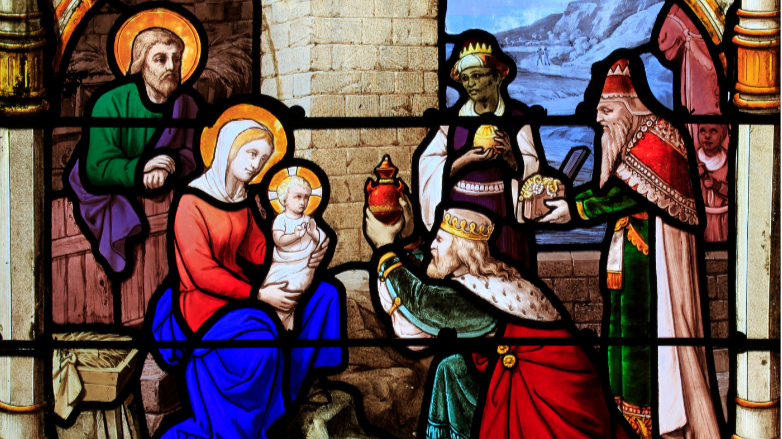
Epiphany is a Greek word that means revelation or manifestation. Two Sundays after Christmas we celebrate the manifestation of the infant Jesus to the three non-Jewish Kings/Magi/Wisemen. Although we celebrated it last Sunday, January 4, I want to address it a little further here. In celebrating Epiphany, we are acknowledging the reality that Jesus Christ, the Savior of the human race, came for all of us, not just the Jews.
The Church originally celebrated four different public manifestations of Christ’s divinity to mankind, in the following order of importance:
1. The Baptism of the Lord. At Christ's Baptism, the Holy Spirit descends and the voice of God the Father is heard by witnesses declaring that Jesus is His Son.
2. Christ's first miracle. At the wedding in Cana, people witnessed Jesus changing water into wine. This miracle manifests Christ's supernatural power, and later, a realization of His divinity.
3. The Nativity of Christ (Christmas). At the Nativity, the angels bear witness to Christ, and the shepherds, representing the people of Israel, bow down before Him.
4. The visitation of the Three Kings, Magi, or Wise Men. At the visitation of the Magi, Christ's divinity is revealed to the Gentiles – “the other nations of the earth.”
The key difference between the fourth manifestation listed here and the other three, is that the visitation of the Magi is the only manifestation of Christ to non-Jews, i.e. Gentiles. In some nations, Christians separate Epiphany from the other manifestations of Christ (epiphanies) by calling this one “Theophany,” “Three King’s Day,” or “The Visitation of the Magi.”
“As with most aspects of the Christian liturgical calendar, Epiphany has theological significance as a teaching tool in the church. The Wise Men, or Magi, who brought gifts to the child Jesus were the first Gentiles to acknowledge Jesus as King, and so were the first to show or reveal Jesus to a wider world as the incarnate Christ [God]. This act of worship by the Magi, which corresponded to Simeon’s blessing that this child Jesus would be "a light for revelation to the Gentiles" (Luke 2:32), was one of the first indications that Jesus came for all people, of all nations, of all races, and that the work of God in the world would not be limited to only a few.”
In some nations, Epiphany is the day in the Christmas season in which gifts are exchanged. This makes more sense than our American tradition of giving gifts on Christmas. Gifts were not exchanged on the day of Jesus birth but days or weeks later when the three Magi brought gifts to baby Jesus (not Santa Claus). Imagine gifts being given two Sundays after Christmas? If this were our tradition, then we’d have two special days in the Christmas season that our wider society would celebrate, Christmas and Epiphany. The focus of Christmas would shift from presents to the birth of Jesus Christ, where the focus should be. This tradition would also help to keep the season of Christmas alive for people as they anticipate presents on Epiphany, one or two weeks after Christmas. As it is now, for almost everyone, there is no Christmas season, just a day. If we exchanged gifts on Epiphany then it might be the day when families gather, the day children long for. It would also highlight the importance of the Holy Day of Christmas: its’ silent intimacy, with the Holy Family in the cave in Bethlehem, the birth of Jesus, and the shepherds in the fields. At Christmas we would put up a tree, start decorating it, and start placing presents under it for the day, one or two weeks from Christmas, when the Magi come to pay homage to the newborn King of heaven and earth – with presents! Perhaps you can start to make some of this part of your family’s Christmas tradition.
All of this is already happening Poland and other Christian nations. An annual event on Epiphany Sunday in Poland, is known as Three Kings Procession. It draws participants who dress as biblical characters, wear paper crowns, and sing Christmas carols while following figures representing the Magi to Nativity scenes set up in public squares. Here’s a photo of people in Poland wearing crowns and processing to town squares to pay homage to the Christ Child not on Christmas, but on Epiphany Sunday. https://www.catholicnewsagency.com/news/268871/nearly-2-million-people-to-march-in-poland-for-three-kings-procession.
I finish this pastor’s column with a tiny bit on the three Magi from Blessed Anne Catherine Emmerich. This is the same author I quoted in recent pastor’s columns on the journey of the Holy Family to Bethlehem and the birth of Jesus there. To find exponentially more on the Three Kings (Magi) you can find all of her writings here https://tandfspi.org/ACE_vol_01/ACE_1_0261_out.html#ACE_1_0000196 .
May the Christ Child Bless You,

Father Thomas Nathe
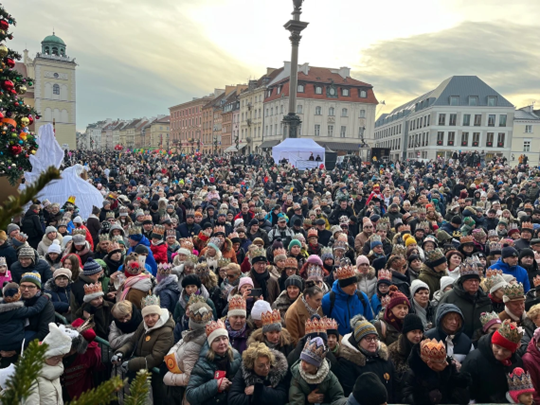
Kings Procession in Poland
___________________________________________________
1. Dennis Bratcher, The Season of Epiphany. Website: Christian Resource Institute. http://www.crivoice.org/cyepiph.html
Taken from The Life of Christ by Blessed Anne Catherine Emmerich—the Three Kings and the Star.
The names Caspar, Melchior, and Balthasar were given to the kings, because they so well suited them, for Caspar means "He is won by love"; Melchior, "He is so coaxing, so insinuating, he uses so much address, he approaches one so gently"; Balthasar, "With his whole will, he accomplishes the will of God."
I heard that the Three Kings traced their genealogy back to Job, who had dwelt on the Caucasus and had jurisdiction over other districts far and wide. Long before Balaam, and before Abraham's sojourn in Egypt, they had the prophecy of the star and the hope of its fulfillment. The leaders of a race from the land of Job had upon an expedition to Egypt, in the region of Heliopolis, received from an angel the revelation that from a virgin the Saviour would be born whom their descendants would honor. They were also instructed to go no farther, but to return to their homes and watch the stars. They celebrated festivals in memory of the event, erected altars and triumphal arches which they adorned with flowers, and then turned back home. There may, perhaps, have been three thousand of these people collected together at this time. They were dwellers in Media and star worshippers, of a beautiful, yellowish-brown color and of tall and noble stature. They roamed from place to place with their herds, ruling wherever they pleased by their irresistible power. They had, as the Kings now related, been the first to announce the prophecy to their people, and the first to introduce among them the observation of the stars. When both the prophecy and the study had fallen into general oblivion, they were received first by one of Balaam's scholars, and long after him by three prophetesses, the daughters of the Three Kings' forefathers. And now at last, five hundred years since the time of those prophetesses, the star had appeared which they were to follow.
All periods, remarkable on account of their reference to the coming of the Messiah, were pointed out to them by visions in the stars. During the last year since Mary's Conception, these visions were more and more significant, and the coming of salvation more explicitly shown. At the time of the Blessed Virgin's Conception, they saw the Virgin with the scepter and the scales in whose evenly balanced plates lay wheat and grapes. They saw, too, a prefiguration of the bitter Passion itself, for they beheld the newborn King involved in a war from which He came out victorious over all His enemies.
This observing of the stars was accompanied by religious ceremonies, fasting, prayer, purification, and self-denial. They watched not one star alone, but a whole constellation; by certain coincidences among the different stars as they gazed, were formed the visions and pictures that they saw. The Kings saw the visions clearly and from them tasted sweet, interior consolation, without feeling the effects of any malign influence. They became, on the contrary, better and more pious. The star was hidden by a cloud; but when it again appeared, looking so large among the drifting clouds and so near to the earth, the Kings arose from their couches, called the people of the city together, and pointed it out to them.
Mensor (Caspar) and Seir (Melchior) were together when they saw in the stars the vision of the birth of Jesus, and both set out on the following day with their respective caravans. Theokeno (Balthasar), also, had the same vision in his own home, and he hurried to join the other two. It was a journey to Jerusalem of about sixty days, each day twelve hours long; but they accomplished it in thirty-three days, on account of the great speed of their camels, and because they often travelled day and night.
The star that guided them was like a ball from whose lower surface light streamed as from an open mouth. It always appeared to me as if guided by an apparition that held it by a thread of light. By day I saw walking before the caravan a figure more brilliant than the light of the sun. When I reflect upon the length of the journey, the rapidity with which they made it appears to me astonishing.
When the caravan set out, the star was visible, shining with a reddish light, like the moon in windy weather. Its train of light was pale and long. The Kings and their followers went part of the way on foot beside their animals, praying with heads uncovered. The road here was such as to prevent their travelling quickly; but when it became level, they mounted and pushed on at a swift rate. Sometimes they slackened their pace and all sang together, the sound of their voices on the night air producing a most touching effect. When I gazed upon them riding forward in such order, their hearts filled with joy and devotion, I could not help thinking: "Ah, if our processions could only pattern after this!"
The star was not constantly shining before them; sometimes it was quite dull. It appeared to shine out more clearly wherever good people lived; and when the travelers beheld it more brilliant than usual, their hearts were filled with emotion thinking that there, perhaps, they would find the Messiah.
Fast forward to the cave at Bethlehem…
Over the cave shone out the star and in the star a Child plainly visible. It stood directly above the Crib, its stream of light falling straight down upon it. The Kings and their followers uncovered their heads and watched it sinking lower and lower, increasing in size as it approached the earth. It looked to me as large as a sheet, I think. All were at first amazed. It was already dark; no dwelling was to be seen around, only the hill of the Crib Cave, looking like a rampart on the plain. But soon their amazement turned to joy, and they sought the entrance of the cave.